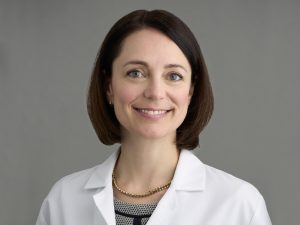
Jane Churpek
Credentials: Associate Professor, Departments of Biomolecular Chemistry and Medicine, UW Carbone Cancer Center, UW Health
Email: jchurpek@wisc.edu
Website: Lab Website
Address:
Wisconsin Institutes for Medical Research (WIMR) Tower I
1111 Highland Avenue, Madison, WI 53705
- Education
- B.S., University of Wisconsin-Madison; M.D., Medical College of Wisconsin; M.S., University of Chicago
- Areas of Expertise
- DNA Metabolism & Genome Maintenance
Hereditary blood disorders, cancer predisposition syndromes, and the genetic mechanisms underlying these diseases
Research Overview
Dr. Churpek’s lab research combines human genetics, molecular biology, and biochemical approaches to uncover mechanisms underlying inherited blood, lung, and cancer disorders. Her group applies cutting-edge functional genomics—including CRISPR-based assays, protein modeling, animal models and cell-based reporter systems—to determine the impact of rare and novel germline variants. By integrating biochemical insights with clinical phenotypes, her work reveals how inherited mutations disrupt cellular pathways such as homologous recombination, replication stress response, and telomere stability. Her laboratory also studies the earliest stages in cancer and blood disorder development trying to understand the multi-step process taking an individual from at-risk to developing overt disease and how exposures may impact this process. All of these efforts have one ultimate goal: help more patients at risk for cancer or blood disorders to lead long, healthy lives.
BRCA1 and Blood Cancer Risk
Dr. Churpek’s clinical observations of leukemia and lymphoma in individuals with an inherited BRCA1 pathogenic variant led her to investigate the broader role of BRCA1 in hematopoiesis. Her research demonstrated that BRCA1 pathogenic germline variants are enriched in individuals who develop therapy-related leukemias after cancer treatment and identified that Brca1-deficient hematopoietic cells exhibit increased sensitivity to DNA cross-linking agents, a hallmark of other Fanconi anemia (FA) pathway deficiencies. Using a conditional Brca1 knockout mouse model, she showed that loss of Brca1 results in spontaneous bone marrow failure, leukemias, and lymphomas, underscoring its critical function in maintaining genomic stability. This work redefined BRCA1 as a key player in the FA pathway and her work continues to explore its impact on hematopoietic malignancy risk and bone marrow dysfunction as well as impact on treatment outcomes.

Genetics and DNA Repair in Mesothelioma
Dr. Churpek’s work explores the role of pathogenic inherited genetic variants in mesothelioma, a cancer traditionally linked to asbestos exposure. Her research identified that 12% of unselected mesothelioma patients carry an inherited pathogenic variant in one of 13 cancer susceptibility genes, most of which are involved in DNA repair pathways. This discovery suggests a broader genetic basis for mesothelioma, highlighting inherited genetic variants as risk factors in disease development and treatment outcomes. Additionally, patients with these inherited variants showed improved survival rates following platinum-based chemotherapy.
Building on these findings, Dr. Churpek is currently investigating how these genetic alterations can predict treatment responsiveness. This research is supported by a Department of Defense Award (W81XWH2110817), where she is using whole genome and RNA sequencing to assess the full spectrum of DNA repair-related genetic changes in mesothelioma. The goal is to develop a predictive model for platinum sensitivity that could be used in clinical practice. Dr. Churpek’s work also focuses on understanding the unique clinical characteristics of individuals with both mesothelioma and a germline pathogenic variant, aiming to refine patient management strategies.

Telomere Biology Disorder
Dr. Jane Churpek’s research related to telomeres focuses on understanding how inherited mutations in genes involved in telomere maintenance contribute to hereditary cancer risk, bone marrow failure syndromes, and pulmonary fibrosis. Her work explores telomere biology disorders (TBDs), a spectrum of rare genetic conditions caused by defects in telomere maintenance genes. Her research integrates family history, clinical phenotyping, genomics of multiple tissues, and laboratory-based functional testing to improve diagnosis and management for individuals and families affected by TBDs.