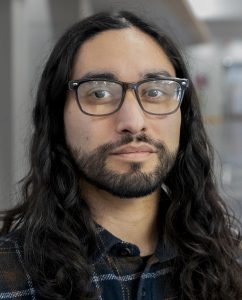
 Robert Mejia, an IPiB graduate student, will be defending his Ph.D. research on September 30, 2026. His research in the labs of Brian Fox and Erica Majumder explored possibilities for engineering E. coli to upcycle sugars from industrial waste into a bioplastic.
Mejia’s work focused on an industrial waste product that, though toxic, is rich in sugars similar to those that E. coli naturally consumes. He successfully engineered a biochemical pathway into a strain of E. coli so that it can use these sugars to produce a bioplastic for industrial and commercial applications. The engineered pathway interrupts the metabolic chain of reactions that E. coli uses to instead produce the bioplastic
While the engineered E. coli is able to grow, proliferate, and produce the desired bioplastic, its growth is initiated four times slower than expected. Mejia believes the culprit of this slow start is the bacteria’s inability to recognize the novel sugar and bring it into the cell. Using proteomics and molecular simulations, Mejia’s data suggest that a transporter protein eventually uptakes the sugar. Further research is needed to identify exactly how the transporter protein impacts cell growth.
Mejia is hopeful that his research will lead to a cost-effective option for bioplastic production. “If we can take a waste stream and efficiently turn it into a bioplastic, we end with a more valuable product than we started with,” he says.
Mejia joined the Fox Lab interested in using biochemistry to address environmental degradation, which he sees as one of the more pernicious problems the Earth is facing. “Most of the environmental crisis is caused by our resource extraction and product disposal,” says Mejia. “Mitigating the negative effects of such environmental crisis is our responsibility because we caused it. I believe that includes shifting our economic model to a more sustainable foundation. My research supports the transition to a circular bioeconomy by contributing to the renewable production of bioproducts.”
In his role as a mentor for undergraduate students in the Fox Lab, Mejia emphasized that fighting habitat loss is the passion that drives his research and encourages students to identify interests and passions that will sustain them through life. “There’s no shortage of worthwhile efforts to dedicate yourself to. But you can’t meaningfully fight them all. You have to choose your battles and show up for the others,” says Mejia.
In addition to his own research, Mejia contributed to work at the Madison-based biotechnology company Xylome as an intern through the Biotechnology Training Program. You can read more about his internship here.
When he was not in the lab, Mejia enjoyed traveling locally and internationally for concerts, camping, and exploring new places. He also loved catching the latest horror movies, playing Dungeons & Dragons, and checking out local events.
To learn more about Mejia’s research, attend his Ph.D. defense, “Waste stream valorization: Engineering E. coli for bioconversion of levoglucosan to polyhydroxybutyrate bioplastic” Wednesday, September 30 at 9:30 a.m. CT in room 1211 of the Hector F. DeLuca Biochemical Sciences Building.
Written by Renata Solan.