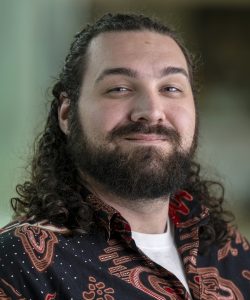
 Colin Hemme, an IPiB graduate student, will be defending his Ph.D. research on December 3, 2026. His research in Timothy Grant’s lab focused on developing improved methods and integrating applications for cryo-electron microscopy (cryo-EM).
Hemme’s research sought to address some of the well-established challenges of cryo-EM by integrating cryo-EM methods with native mass spectrometry and nuclear magnetic resonance (NMR).
“In my research in the Grant Lab, we combine methods and approaches to identify ways that they can work better together than they do separately to solve a protein structure,” Hemme explains. For Hemme, this meant collaborating with other IPiB labs to explore possibilities for combining cryo-EM with mass spectrometry and NMR.
Hemme worked with the Coon Lab in the Biomolecular Chemistry Department to develop a cryo-EM sample preparation method that addresses sample degradation at the air-water interface. The molecules at the edges of cryo-EM samples can become distorted due to interactions where air meets the sample’s aqueous solution. Hemme found that particles can be deposited using a mass spectrometer, potentially avoiding the air-water interface. He says that fine-tuning is still needed to obtain clearer structures of deposited particles, though one promising approach could be melting surrounding ice with a laser and then quickly re-freezing the sample.
With members of the Rienstra laboratory in the Biochemistry Department, Hemme helped apply cryo-EM image alignment methods to align NMR spectra. His protocol uses spectra as images (similar to how cryo-EM data is processed) rather than discrete data points, allowing NMR data to be visually aligned. The approach is both effective and less complex than other algorithms that were being applied to similar data.
“This research is an example of how important it is for structural biologists who take different approaches to science to collaborate and share ideas,” says Hemme. “Scientists use different methods, and sometimes we’re inclined to defend how robust our own approach is, but it’s not about which approach is better. For some things, cryo-EM is the best approach we currently have. For some things, NMR will give us clearer information. And what we are finding is that combinations of methods and approaches can be even more powerful.”
Hemme came to IPiB with an interest in structural biology. While here, he developed interests in mentorship and writing, ultimately earning a graduate minor from the Life Sciences Communication Department. “I love mentoring, teaching, talking to people, and communicating about science,” Hemme says. “I want to contribute to a positive dialogue about science and making it feel more approachable, so people don’t feel so afraid of what they don’t understand.” Hemme plans to pursue a career that combines communication with scientific inquiry and discovery.
Hemme also participated in Catalysts for Science Policy (CaSP), a group of graduate students and postdoctoral researchers that educates the public and engages with science policy, where he ran career workshops, wrote a monthly newsletter, hosted podcast episodes, authored policy memos, and redesigned the website.
To learn more about Hemme’s research, attend his Ph.D. defense, “Development of integrative structural biology methods with a focus on cryo-electron microscopy” on Thursday, December 3 at 9:00 a.m. CT in room 1211 of the Hector F. DeLuca Biochemical Sciences Building.
Written by Renata Solan.