
In this edition:
Research from the Hoskins Lab in the Department of Biochemistry uncovers new details about the careful way our genetic material is processed to produce proteins. Here’s the run down on their latest research, published in RNA:
- RNA is processed to ensure that it codes for the proteins our bodies need. One of these processes is pre-mRNA splicing.
- Malfunctions in pre-mRNA splicing can result in faulty proteins that are responsible for diseases including cystic fibrosis, muscular atrophies, and cancers.
- Researchers in the Hoskins Lab identified a new way cells make sure that pre-mRNA splicing occurs at the right location to produce the right RNAs.
What background information do you need to know?
In school, we learn that DNA is transcribed into mRNA and mRNA is translated into amino acids that assemble to build proteins. While this description is a good overview, it’s not the whole story. The messenger RNA (mRNA) that serves as the genetic code for proteins is not an exact transcription of our DNA. Along the way, different modifications and processes ensure that mRNA results in the proteins our body needs at any given time.
You may remember another tidbit from school: exons express. This mnemonic device helps us remember that sections of pre-mRNA (mRNA that is still being processed and packaged) called introns are spliced out of the pre-mRNA strand, leaving behind a string of exons constituting the genes that are expressed, or that code for specific proteins. The process of removing introns and connecting exons to ensure that mRNA correctly codes for proteins is called pre-messenger RNA (pre-mRNA) splicing.
The molecular complex responsible for pre-mRNA splicing is called the spliceosome. The spliceosome is made up of dozens of proteins and five small RNAs. It is responsible for locating the beginnings and ends of introns and exons, cutting mRNA at just the right spot, joining the exons back together, and checking for errors during those steps. Though critically important, how the spliceosome decides which pre-mRNA sequences to remove and which to keep is not fully understood.
Why is it complicated to understand how lipids impact health?
When splicing is off by even a single RNA base, it can have devastating impacts. One such mistake can result in the genetic disorder cystic fibrosis. A mutation that causes splicing to occur just a few bases off changes the amino acid sequence of a protein involved in lung function. The result is that mucus and other bodily fluids thicken and clog organs, including the lungs and digestive pathways. Learning more about the spliceosome can help us identify mechanisms responsible for some diseases and can provide potential targets for future therapeutics.
 How have scientists made progress?
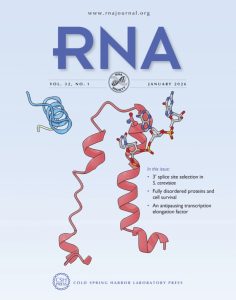
Researchers in the Hoskins Lab are studying a region in one of the spliceosome’s proteins that is highly conserved across species, including humans and yeasts. In work that recently appeared on the cover of RNA, the researchers identified that this protein, called Prp8, plays a key role in ensuring that pre-mRNA is sitting in the right place so that splicing occurs at the intersection of an intron and exon. Their research also indicates that Prp8 is part of the spliceosome’s proofreading machinery, helping to initiate corrective measures if splicing occurs in the wrong location.
This expanded understanding of how the spliceosome recognizes where to cut RNA will help scientists interested in exploring why this system sometimes malfunctions and how to fix it.
Written by Renata Solan.
In Research In Brief: The What, Why, and How, we explore new research from the UW–Madison Department of Biochemistry to learn more about the world around us — and inside us.
This edition of Research in Brief: The What, Why, and How is based on the following publication: Liu, Paulson, and Hoskins. Control of 3′ splice site selection in S. cerevisiae by a highly conserved amino acid within the Prp8 α-finger domain. RNA, January 2026, 32: 82-96. This research was funded in part by the National Institutes of Health (NIH).