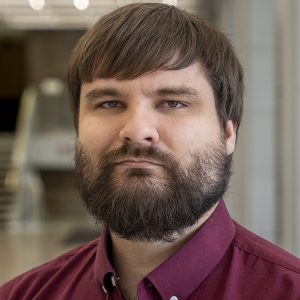
 Ross Soens, an IPiB graduate student, will be defending his Ph.D. research on December 5, 2025. His research in the Coon Lab explored post-translational modifications, and modifications made during translation, to proteins.
There are myriad ways proteins can be modified to gain new functions or turn off unwanted capabilities. These are known as post-translational modifications. Modifications can also be made as the protein is built. These are known as co-translational modifications. Both types of modifications can influence protein structure and function.
“I like to think about building a protein as similar to the process of building a house,” explains Soens. “The RNA is like the blueprints for making the house, and then the protein is the house itself. Adding on a garage later, five years after you’ve built the house, that’s a post-translational modification. Telling the builders to add a garage while the house is still being built, that’s a co-translational modification.”
Soens’s early doctoral work focused on the conditions needed for a specific co-translational modification that impacts cell growth. Later, Soens sought to develop mass spectrometry techniques to produce a more comprehensive profile of acetylation, a type of post-translational modification, in mammalian cells.
“Acetylation is well-studied because we know it is an important process that can modify gene expression. We know that dysregulation to this process is linked to a lot of diseases, including Cancer and Alzheimer’s Disease,” says Soens. “Mapping novel protein acetylation sites could help us find new acetylation sites involved in disease or in biological processes.”
Interested in learning about careers beyond academia, Soens joined the IPiB program as a member of the NIH-funded Biotechnology Training Program (BTP). Upon accepting an NSF Graduate Research Fellowship, he decided to leave BTP (students cannot accept simultaneous funding from two federal grant programs). At this and other critical junctures in graduate school, Soens says his committee members and mentors helped him make decisions that were right for him and his career goals.
“I really want to give big kudos to everyone on my committee. Professor Coon has been very supportive of my career goals and helping me get across the finish line. And my whole committee, especially Professor Judi Simcox, has been incredibly helpful and approachable for scientific advice and for life advice,” says Soens. Soens also found community and support playing Dungeons & Dragons with fellow IPiB graduate students.
In January, Soens will begin a position at Promega Corporation, a biotechnology company in Madison.
To learn more about Soens’s research, attend his Ph.D. defense, “And Another Thing: A Beleaguered and Winding Approach to Improve Understanding of Mammalian Post-Translational Modifications” on Friday, December 5 at 1:00 p.m. CT in Room 1211 of Hector F. DeLuca Biochemical Sciences Building.
Written by Renata Solan.