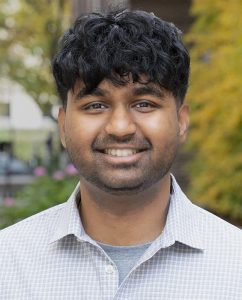
 Rohith Rajasekaran, an IPiB graduate student, will be defending his Ph.D. research on November 21, 2025. His research in the Coyle Lab explored how to repurpose cellular systems that exist in nature to engineer new functions into cells.
His work focused on engineering a biochemical signaling system that creates dynamic patterns of biochemical activity, organizing molecules to the right places at the right time in a cell. The system, known as the MinDE reaction-diffusion system, is native to bacteria. Rajasekaran engineered MinDE protein systems into mammalian cells to produce patterns of organization that couple to native function in a cell. The work, which was published as a cover story in Cell, can ultimately help researchers gain understanding about cell behavior.
Rajasekaran also demonstrated that, by monitoring the frequency and amplitude of oscillating waves engineered into embryonic stem cells, researchers can track cells differentiating into different germ cell layers, a critical step in embryonic development.
“I expanded the system beyond traditional cell culture to explore a more biologically meaningful application, studying early differentiation using stem cells as a model,” explains Rajasekaran, whose work was supported in part by a 2025 Distinguished Graduate Student Fellowship recipient from the College of Agricultural and Life Sciences. “We’re able to track the developmental trajectories in real time across the entire differentiation for a populations of cells. We can visually inspect cells as they differentiate and assess developmental processes.”
In addition to his own research, Rajasekaran mentored two undergraduate students in the Coyle Lab.
Rajasekaran participated in the UW–Madison Chemistry-Biology Interface Training Program (CBI), a two-year program funded by the National Institutes of Health National Institute of General Medicine Science (NIH NIGMS). Through the program, which is designed to provide students with interdisciplinary scientific education and professional development, Rajasekaran was able to look behind the scenes at the grant review and funding process as a graduate student liaison to NIGMS.
“It gave me an opportunity to experience another side of academic research,” says Rajasekaran. “I was part of interviewing new candidates, evaluating applications, and bridging communication between students within the fellowship cohort and program administration.”
After graduating, Rajasekaran will begin a position at the University of California, San Francisco as a post-doctoral researcher.
To learn more about Rajasekaran’s research, attend his Ph.D. defense, “A programmable reaction-diffusion system for spatiotemporal cell signaling circuit design” on Friday, November 21 at 2:00 p.m. CT in Room 1211 of Hector F. DeLuca Biochemical Sciences Building.
Written by Renata Solan.