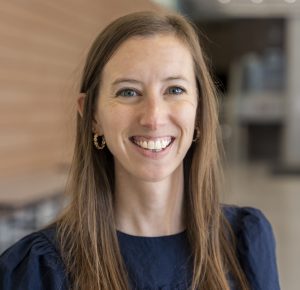
 Jessica Davidson, an IPiB graduate student, will be defending her Ph.D. research on April 16, 2026. Her research in the Simcox Lab explored how lipids are regulated under conditions of metabolic stress, such as cold exposure and disease.
Davidson came to graduate school interested in building her skills as both a bench lab and clinical researcher. As part of her bench work in the Simcox Lab, Davidson identified an enzyme in the lysosome, Pla2g15, that helps to break down lipids that control cellular energy expenditure. Her findings indicate that Pla2g15 may play an important role in our survival during times of metabolic stress. The research was published in Cell Metabolism.
In a separate, translational project, Davidson is exploring whether certain lipids in the blood may suggest an increased risk of heart disease. Using blood samples collected through the Diabetes Research Accelerator of Wisconsin (DRAW) over the past 30 years, Davidson is analyzing lipid composition and abundance to assess whether there are correlations between the abundance of certain lipids and the development of heart disease in participants in the DRAW study.
“We’re re-enrolling as many people as we can to re-take measurements first taken decades ago. ” says Davidson. “This means that we can look over time and ask who developed heart disease, who didn’t develop heart disease, and how have their lipid profiles changed?”
The study, Davidson says, has given her an opportunity to connect with study participants and witness the impact of translational research firsthand. “I walk around and talk to the participants that come through the hospital. People have driven from as far as Green Bay to come back and contribute to this research. There are people who work two jobs to provide for their family, who are taking a day off work to come down here and volunteer their time. It is a full day, and after that, they might have a long drive home,” says Davidson, who notes that participants are required to fast, undergo multiple blood draws, withhold medication, and have a variety of scans.
“It is incredible to have interactions with the population you’re trying to serve with your research. That’s why I do research. I was raised to ask questions, to try to help people with everything that I do. Judi [Simcox] helped to facilitate a project that fit everything that I wanted to do and that allows me to see the impact of my work. I hope that I can continue to find a way to integrate whatever communities I’m serving with my research into my research, because I think that that’s where the best ideas come from.”
This summer, Davidson will begin a position as a postdoctoral researcher in the Chapman Lab, a neuroscience lab in the UW–Madison School of Medicine and Public Health. This pivot will allow Davidson to put her skills to work in a new system. “Metabolism is a way that cells interact with their environment, how they receive signals, how they send out signals, how they process things. A neuron does that, too. I’m going to specifically be looking at…ways our brain communicates, which involves lipids.”
Davidson decided to stay in Madison for this exciting new research opportunity and life circumstances. Davidson and her husband, who works in Madison, recently welcomed a baby, and the family wished to remain rooted in their current community. Although splitting her time between parenting and scientific research has been challenging, Davidson feels proud to model for her daughter and peers that she can prioritize and succeed at both. She even makes time to continue her hobby of long-distance running. “My husband asked me to think about what kind of mom I would be if I didn’t model what I want my daughter to grow into. I love my science. I love running. He reminded me that I don’t have to give those up just because I’m also a mom,” Davidson says. “My time will always be split. But there is a way to balance it, and that doesn’t mean I’m less dedicated or less productive than anyone else in my lab.”
To learn more about Davidson’s research, attend her Ph.D. defense, “Exploring lipid regulation in metabolic stress” on Thursday, April 16 at 10:30 a.m. CT in Room 1211 of Hector F. DeLuca Biochemical Sciences Building.
Written by Renata Solan.