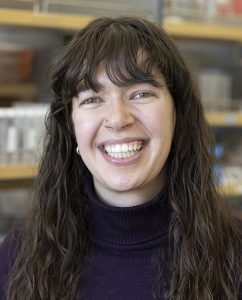
 Corinne Moss, an IPiB graduate student, will be defending her Ph.D. research on May 6, 2026. Her research in the Coon Lab explored new ways to use technology to study metabolites in urine.
Through our urine, we excrete metabolites — small molecules such as vitamins and amino acids produced through metabolic processes — that can offer clues about our overall health. Changes in metabolites can provide information about diet, exercise, disease, and organ function. But, with thousands of different molecules in our urine, it can be difficult to obtain an accurate catalog of metabolites from urine samples.
Mass spectrometry technology traditionally used to analyze the composition of metabolites in a sample sometimes misses essential compounds that are both small and scarce. Moss investigated if she could catalog metabolite composition in greater detail by pairing capillary electrophoresis (which separates molecules in solution from each other) with a highly sensitive mass spectrometry technology commonly used to study protein composition. She analyzed the resulting data to deepen our understanding of what studying urine can reveal about human health.
“We can learn from what is excreted because it gives us signals about what is changing or shifting. We have all these metabolites in our urine, so the question is whether we can directly relate those metabolites to the things happening in a person’s life, including stress, diet, lifestyle, and disease,” says Moss.
Moss found some clear patterns between metabolite composition and certain behavioral patterns in participants who tracked their diets, sleep, exercise, and other lifestyle variables over two weeks. Notably, she says, the presence of certain metabolites was correlated with caffeine consumption, and others were correlated with exercise.
“There’s still a lot to learn about how to use this data, but can we use metabolites in urine to predict something like the amount of protein a person ate? The short answer is yes,” says Moss, who also believes the methods she used can create opportunities to improve treatment outcomes. “In the future, maybe we can also use information from urine to see how a patient is responding to treatment or to get a better idea of what treatment is going to be most effective based on other metabolic information that we have about how the body is functioning. Those are really exciting possibilities.”
Moss’s data also revealed day-to-day fluctuations and individual variation in toxic “forever chemicals” such as PFAS, which were present in urine from all of the participants. An enthusiastic lover of biking, distance running, swimming, and the outdoors, Moss hopes such data could eventually even be used to demonstrate geographical locations in need of environmental remediation.
Through the Scientific Teaching Fellows program at the Wisconsin Institute for Science Education and Community Engagement (WISCIENCE), Moss also discovered a passion for teaching. Her training through WISCIENCE, as well as her work as a teaching assistant for Biochemistry 551 and her experiences mentoring undergraduate researchers in her lab, helped her to secure a new position teaching chemistry as an assistant teaching professor at Boise State University. Originally from Colorado, Moss is looking forward to returning to a mountainous terrain this fall when she moves to Idaho.
To learn more about Moss’s research, attend her Ph.D. defense, “Mass spectrometry approaches to technical and biological studies with human urine” on Wednesday, May 6 at 3:00 p.m. CT in room 1211 of Hector F. DeLuca Biochemical Sciences Building.
Written by Renata Solan.