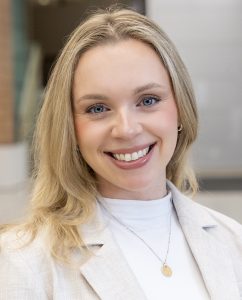
 Haley Deorio, an IPiB graduate student, will be defending her Ph.D. research on May 5, 2026. Her research in the Keck Lab explored regulation of a pathway necessary for restarting failed DNA replication events in bacteria.
Healthy cell division depends on accurate genome replication so that new cells inherit the same genetic code as their parent cells. Errors and malfunctions in DNA replication can cause cell death in single-celled organisms such as bacteria and can lead to cancer and other diseases in more complex organisms.
Previous work in the Keck Lab identified a conformational change in the PriA protein, the master orchestrator of the PriA-PriB DNA replication restart pathway in E. coli. When DNA replication has stalled, PriA recognizes and binds to the abandoned DNA replication to restart the process. Deorio’s research sought to better understand how the DNA replication fork structure and a conformational change in PriA regulates the PriA-PriB DNA replication restart pathway using electron microscopy and in vitro biochemical assays. Deorio found that interaction between PriA and DNA replication forks with a single-stranded lagging template induces a conformational change that exposes additional docking sites on PriA for the PriB and DnaT proteins. The conformation change allows PriA to examine the structure of the lagging template strand, ensuring that docking of PriB and DnaT occurs only on certain strand configurations required for replisome reloading.
The process of DNA replication is highly conserved across organisms, making studies of bacterial replication informative for understanding the process in humans. “Things like sun exposure or ingesting harmful chemicals such as PFAS through our food and water can compromise our DNA,” says Deorio. “By understanding DNA replication pathways and repair techniques in very simple organisms, we can begin to anticipate the challenges our own cells may face and start looking at ways to mitigate harm.” Deorio’s research has been published in Nature Communications.
For Deorio, questions remain about the pathway she studied. She will continue as a postdoctoral researcher in the Keck Lab, studying the role of another protein in the pathway, DnaT.
During her time in graduate school, Deorio served as a WARF Ambassador, strengthening connections between campus research and technology transfer as a liaison at the Wisconsin Alumni Research Foundation (WARF). She also participated in the WiSolve Consulting Group. These experiences have led Deorio to consider how her training as a scientist has prepared her for a wide range of careers, both in and out of the lab. “I’m interested in licensing and intellectual property of therapeutics. I understand science, I know how to vet good science, and I want to spend my time learning new science and being intellectually challenged,” says Deorio, who hopes her career will eventually lead her back to the East Coast to be closer to family.
Deorio says her time in graduate school has been about so much more than research. “You’re here during critical years in your life, and your life doesn’t just stop because you’re in graduate school,” she reflects. “I moved to Madison in 2021, just a year after my dad passed. I was meeting new people and learning new techniques. And, I was also processing all that had just happened.”
Deorio credits her fiancé, close friends she made through IPiB and her lab, her two cats, and the lessons she learned from her parents with helping to support her through the ups and downs of research and life events. “I think a lot of my drive came from my mom and dad. They had to work hard through tough times to build a life. I saw them do it, so I know I can do it. Sometimes we think of our science as being separate from our lives. But my life has shaped me into the scientist that I am. Your work comes home with you, and your life comes to work with you. So graduate school is about developing professionally, but it’s also about developing personally and finding people who matter to you and making memories.”
To learn more about Deorio’s research, attend her Ph.D. defense, “Replication fork-induced dynamics in the PriA DNA helicase regulate bacterial replication restart.” on Tuesday, May 5 at 1:00 p.m. CT in room 1211 of Hector F. DeLuca Biochemical Sciences Building.
Written by Renata Solan.