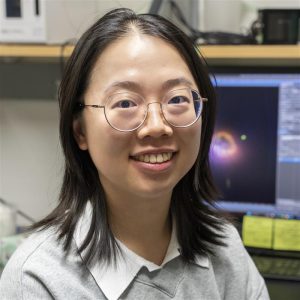
 Zhejing Xu, an IPiB graduate student, will be defending her Ph.D. research on May 11, 2026. Her research in the Coyle Lab sought to understand how subcellular structures self-organize. Using systems biology and synthetic biology, Xu studied how predatory protozoa adapt cell morphology to optimize feeding efficiency in response to environmental demands.
Xu studied the specialized feeding tentacles that Podophyra collini uses to trap prey, uncovering a genetically encoded tradeoff between tentacle number and length. In prey-limited environments, the organism reduces the number of tentacles to conserve energy until it is able to feed, restoring the number of tentacles only after feeding. Xu quantified this behavior through transcriptomics, proteomics, ultrastructural analyses, and mathematical modeling, connecting environmental conditions, predatory capacity, and molecular mechanisms.
“Normally, we think about size scaling isometrically: they’re happening equally in all directions, so an increase in number will be met with an increase in length. But based on our observation, it seems like the scaling logic in this specific organism is biased towards the number of tentacles, and this kind of biased scaling relationship allows the organism to implement efficient predation strategies,” says Xu.
The research, Xu says, strikes a balance between basic science research on an understudied organism with insights into how cells organize. The knowledge, she says, can inform the engineering of new cellular functions. It also revives lines of inquiry that have been dormant for decades.
“There is a lot of basic research to be done on this organism because the only literature you can find is back in the 1970s and 1980s. I really feel like I’m communicating through time, talking to people who did research 50 years ago. And then, someday, the next person will be communicating with my research when we have new technology that allows them to learn things I couldn’t ask about,” Xu says. “I think we’re in a protozoan renaissance, and we’re starting to appreciate how we can use these single, eukaryotic cells to understand basic cell behavior.”
Xu was drawn to IPiB by the enthusiastic, welcoming students and Madison’s accessibility and proximity to parks and outdoor opportunities. She arrived just as the Coyle Lab was forming. She saw Scott Coyle as a mentor who would help her home in on her interests and who would be excited for her to do research that interests her. “There wasn’t much in the lab when I arrived because it was still being set up. At first, there was just a dissecting scope. One day, Scott suggested that we go on a field trip to collect samples from a nearby pond and look at the protists in the samples under the microscope. I’m from a plant science background, and I saw the opportunity in this lab to connect with and interact directly with what’s happening in nature,” remembers Xu.
Xu plans to work as a postdoctoral researcher after she graduates. “I’m really interested in basic biology, understanding how organisms communicate with each other across cells or interact with the environment. It makes me feel energized to think about the possibilities,” says Xu.
To learn more about Xu’s research, attend her Ph.D. defense, “Understanding the control logic of subcellular self-organization: From ciliate biology to synthetic systems,” on Monday, May 11, at 12:00 p.m. CT in room 1211 of the Hector F. DeLuca Biochemical Sciences Building.
Written by Renata Solan.